A Simple Timer Guide for Pour-Over Coffee: Bloom, Pulse Pours, and Finish
Pour-over coffee rewards attention, and the simplest tool for paying attention is a timer. Not because a number on a screen improves the taste by itself, but because time is the clearest language for describing what your hands are doing: when you pour, how much, how fast, and how long the bed takes to drain. Once those moments are repeatable, you can change one thing at a time and actually know what changed.
What follows are benchmark timings for a standard pour-over — bloom, pulse pours, drawdown, total finish — with the reasoning behind each one, so you can adapt them to your dripper, your dose, and the coffee in front of you. Treat the numbers as a starting line, not a finish line.
What the Timer Actually Tells You
A brew timer measures three things worth knowing: contact time (how long water sits with the coffee), pour rhythm (how often fresh water enters the bed), and drawdown speed (a rough proxy for grind and filter flow). Together those describe a brew far better than "about three minutes" ever could.
What the clock cannot do is taste for you. A 3:10 brew that tastes hollow and thin is not a success just because it landed inside the window. Taste decides; the timer explains. That said, if you change nothing else and your brew time swings by forty seconds from cup to cup, your pouring is probably the variable. Tighten the rhythm before reaching for the grinder.
For the benchmarks below, assume a medium-fine grind, water just off the boil (roughly 92–96°C depending on the roast), a rinsed paper filter, and a 1:16 coffee-to-water ratio.
Bloom: The First 30–45 Seconds
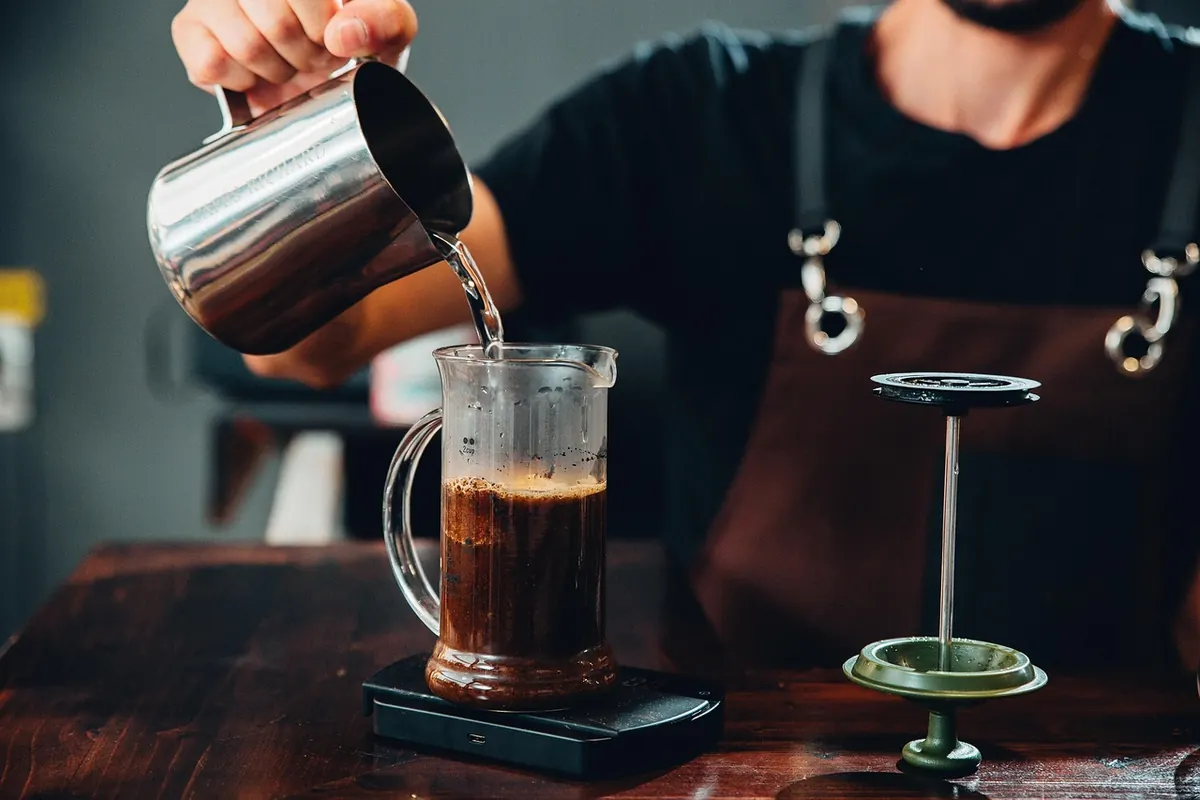
Start the timer the moment water first touches the grounds. Pour two to three times the weight of the coffee — 30–45g for a 15g dose — in a slow spiral, making sure every dry pocket is saturated. Then stop, swirl the dripper gently if you like, and wait.
The bloom is fresh coffee releasing carbon dioxide. That gas pushes back against the water, so the bed puffs and bubbles and sometimes looks like a small loaf of bread. Wait until the rise has clearly finished and the bed begins to settle: 30 seconds minimum for most coffees, closer to 45 for very fresh roasts. Taste matters more than the clock here. A bloom cut short leaves gas in the bed, which disrupts the pours that follow and often gives you a cup that tastes sharp at the front and hollow in the middle.
Reading the bloom
- Big, lively dome that is slow to fall: very fresh coffee. Give it the full 45 seconds.
- Modest rise, settles quickly: the coffee has rested a while. 30 seconds is plenty.
- No rise at all, water pooling on top: usually stale coffee or too fine a grind — check the grind first.
Pulse Pours: Building the Middle
After the bloom, most brewers do better with a series of small pours than one big dump. Each pulse adds fresh water, agitates the bed, and keeps the slurry temperature stable. A steady, gentle spiral from the centre outward works better than a hard pour, which disturbs the filter walls and sends fines to the bottom where they choke the flow.
A workable rhythm for 15g of coffee and 250g of water:
- 0:00 — start the timer, bloom with 45g of water.
- 0:40 — first pulse to 120g, pouring in slow circles.
- 1:10 — second pulse to 175g.
- 1:40 — third pulse to 220g.
- 2:05 — final pulse to 250g, then let it drain.
Wait for the water level to drop close to the top of the bed before each new pour. If you are pouring every twenty seconds because the bed drains instantly, your grind is likely too coarse. If the level barely moves between pulses, it is too fine, or you are pouring with too much force.
The pulses do not need to be perfect. They need to be consistent enough that you can tell when something has changed.
Drawdown: The Last Minute
Drawdown is the final drain after your last pour, and it is the most honest feedback a brew gives you. Watch the bed: it should finish flat and level, maybe slightly domed in the centre — not cratered, not piled against one side.
For the 250g brew above, aim for the water to disappear somewhere between 2:45 and 3:15. Much faster and you probably ground too coarse, poured too hard, or used water that was not hot enough to extract properly. Much slower and the cup will often taste bitter and drying, with a heavy finish that lingers longer than you want.
Do not judge drawdown in isolation. A fine grind in a fast-filtering cone can drain in three minutes and still taste muddy, while a coarse grind in a slow dripper can take four minutes and taste thin. Time plus taste is the whole picture.
Total Brew Time Benchmarks
These are starting points for a standard cone dripper, not rules. Adjust to your equipment and keep a few notes.
- 15g coffee / 250g water: 2:30–3:15 total.
- 20g coffee / 320g water: 3:00–3:45 total.
- 30g coffee / 500g water: 3:30–4:30 total.
Larger doses need more time because there is more coffee to extract and more water to move through the bed. If you double the dose without touching the grinder, expect the brew to run long — grind a touch coarser to compensate, then taste and adjust.
When the Clock Disagrees With Your Palate
The timer is a diagnostic tool, so use it that way:
- Sour, and the brew finished early: grind finer or slow your pours.
- Bitter, and the brew ran long: grind coarser or pour with less agitation.
- Tastes good but sits outside the window: leave it alone. Your grinder, filter and dripper are simply different from the numbers.
- Time varies wildly between identical brews: your pouring is inconsistent. Practise the same spiral and the same pulse weights.
Keep the Clock, Lose the Anxiety
A timer should make brewing calmer, not more stressful. Set the benchmark, pour with attention, and check in at three moments: the end of the bloom, the final pulse, and the moment the bed drains. That is enough to know whether a brew was in the ballpark.
Try running the same recipe for five mornings without changing anything. Once your pours settle into the same rhythm each day, the numbers stop being targets and start being a language you can use to adjust the cup in front of you. That is the real benefit: not a perfect time, but a brew you can repeat and refine.
Local Roaster Spotlight: How to Choose Beans from a Nearby Coffee Roaster
A practical guide to buying beans from a nearby roaster — how to read roast dates, what to ask at the...
Weekend vs. Weekday Coffee Brewing: A Time-Saving Routine Checklist
A practical checklist for splitting your coffee routine in two: fast, repeatable weekday brews and slower...
About Us